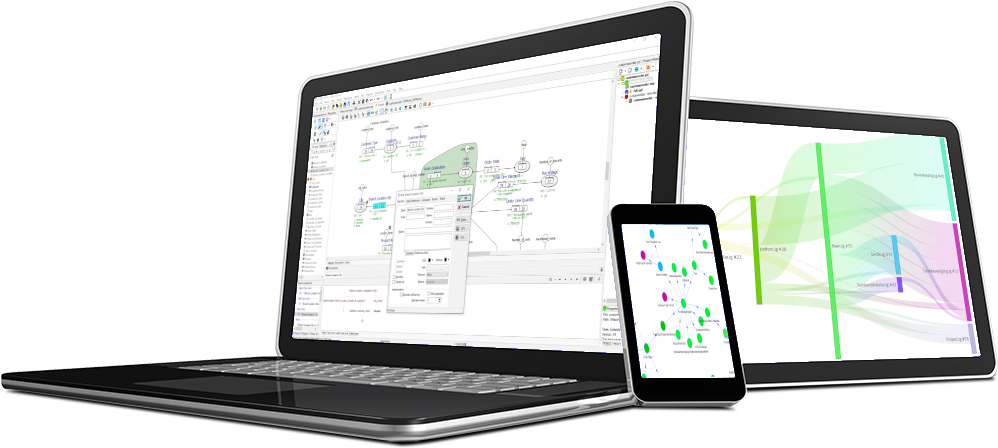
Generate database schemas, API specifications, and code scaffolds from conceptual models. Start with understanding, deliver working software.
What CaseTalk Generates
|
Database DDL
|
API Specifications
|
|
Code Scaffolds
|
Semantic Web & AI
|
developer workflow
How developers typically use CaseTalk:
-
Get the Model
Analyst/architect creates conceptual model -
Generate Schema
Export DDL for your target database -
Generate Code
Export classes/Structs for your language -
Iterate
Model changes? Regenerate artifacts
Technical articles
Understand the technical aspects:
-
Python DataClass
In response to Python's growing popularity among developers, CaseTalk extends its support to help developers align their work with business requirements. We've harnessed the power of Python's dataclasses to bridge this gap. However, dataclasses alone offer limited support for the rich conceptual information models in CaseTalk. To overcome this limitation, we've incorporated metadata support.
-
Generated ERD, UML and Concept Map
This short video demonstrates how CaseTalk automatically generates ERD, UML Class Diagram and simplified Concept Map.
-
Reverse Engineering
The reverse engineering creates an elementary CaseTalk model through a simple ADO connection. The tables, columns, key information, and relations are all created as facts and are made to be verbalized. This way, the database model can be validated as a conceptual model following the regular rules.
-
Development with FCOIM and UML
Software evolves rapidly, often outpacing changes in data structures. Over time, applications undergo transformations, upgrades, or migrations to new platforms. Effective software design plays a crucial role in managing the application life cycle. While widely used, the traditional UML design approach can sometimes be imprecise.
-
Transformation of Models
A conceptual information model of the business is a great asset, as well as a solid investment due to it being independent of technology. Since IT undergoes rapid changes, the only truly long-living asset is the information model.