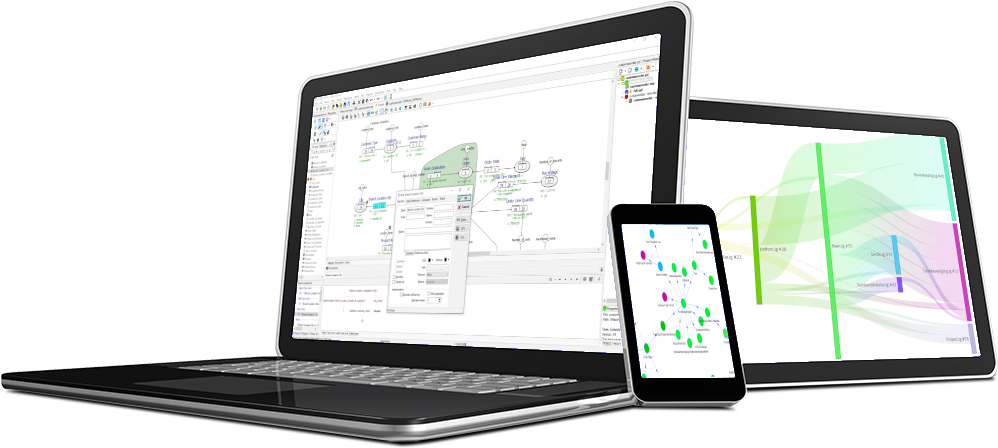
Design at the conceptual level, generate technical artifacts automatically. Bridge enterprise architecture with database implementation.
generation capabilities
From one conceptual model, CaseTalk generates multiple technical outputs:
|
Database Schemas SQL Server, Oracle, PostgreSQL, MySQL, SQLite, and more |
API Specifications JSON Schema, XML Schema, OpenAPI |
|
Ontologies OWL/RDF, LinkML for semantic web |
Diagrams ERD, UML, C4, Concept Maps, Knowledge Graphs |
Architecture articles
-
Titanic Data (Model)
On many conferences where AI, ML or data science is mentioned, a simple dataset is used to underpin the storyline of the sessions. The Titanic dataset is such a relatively small and simple example. Until now a Fact Oriented Model was absent. So, let's see how we can build one out of the dataset by verbalizing it.
-
Governance with DMBOK
The DAMA organization has created an enormous body of knowledge called the Data Management Body of Knowkledge ( DMBOK ). In version 2 they introduced Fact Oriented Modeling for the first time. Both ORM and FCO-IM are condensely described. To illustrate how governance is central in the huge field of data management is shown by the DMBOK Wheel.
-
Foreign Keys are easy
Every now and then a discussion arises on social media, or during a conference meet-up, where the conversation or question focusses on the topic of Foreign Keys. Traditional modelers seem to occasionally struggle with foreign keys in respect to one-to-one, one-to-many, and many-to-many characteristics, or the minimal and maximum cardinality, or its direction. This is not a big issue in Fact Oriented Modeling, since foreign keys are simply generated from a conceptual model. Foreign keys are a result of fact types and their transformations. The direction and cardinalities of the foreign keys are determined by simple rules from the conceptual model.
-
Advantages of Fact Based Modeling
In the realm of data modeling, the FCO-IM (Fully Communication Oriented Information Modeling) method has emerged as a powerful successor to the well-established NIAM (Natural Information Analysis Method). Both approaches rely on the use of natural language to construct data models. FCO-IM, however, takes this methodology a step further, offering numerous advantages that make it an ideal choice for creating elegant and highly adaptable models, all the while ensuring ease of validation by both business experts and users.
-
Full Data Architecture
Information architecture distinguishes between different layers and compartments, each with specific models. The compartments are then ordered and their models aligned. This article described the compartments and models influenced by CaseTalk and by Fact Based Modeling.
-
Transformation of Models
A conceptual information model of the business is a great asset, as well as a solid investment due to it being independent of technology. Since IT undergoes rapid changes, the only truly long-living asset is the information model.
-
Zachman Framework
Information systems are meant to automate the repetetive tasks of the employees of your business. Systems administer data relevant to it's business owners and users (E.g.: people, places, things, events and reasons). Designing these systems requires lists of datamodels, proces models, database models, schemas and diagrams with object classes, procedures, documentation sets, and lots more.
-
Why Communication Matters
Fully Communication Oriented Information Modeling (FCO-IM) emphasizes modeling the communication aspect of data. Employees constantly exchange facts through communication, such as "Invoice 1238 has an invoice date 1-1-1999". FCO-IM models such communication and facts in natural language. This article highlights the importance of communication in developing a fact-based data model.
Tool integration
-
Supporting ER/Studio
Idera ER/Studio is a data modeling tool with a modern interface, supporting a wide range of databases. CaseTalk supports the logical data models using a script generator. Generated script can simply be executed inside ER/Studio in order to have the logical model automatically build for you.
-
Supporting PowerDesigner
PowerDesigner is a tool used by many data architects. CaseTalk strengthens them by using language, well-documented entities, and tables. However, if your goal is simply to draw a relational diagram, you should perhaps consider using the CaseTalk Viewer.
-
Denodo Data Virtualization
Denodo is a Data Virtualization environment that simplifies the process of moving data from one place to another. This is done through configurable layers containing various views, which are based on table definitions that live in source systems. The upper layers of views should represent business needs and require solid data modeling. These layers act as an interface, and are usually designed top-down, meaning fields are first defined and the implementation (data) of the interface is associated later.